
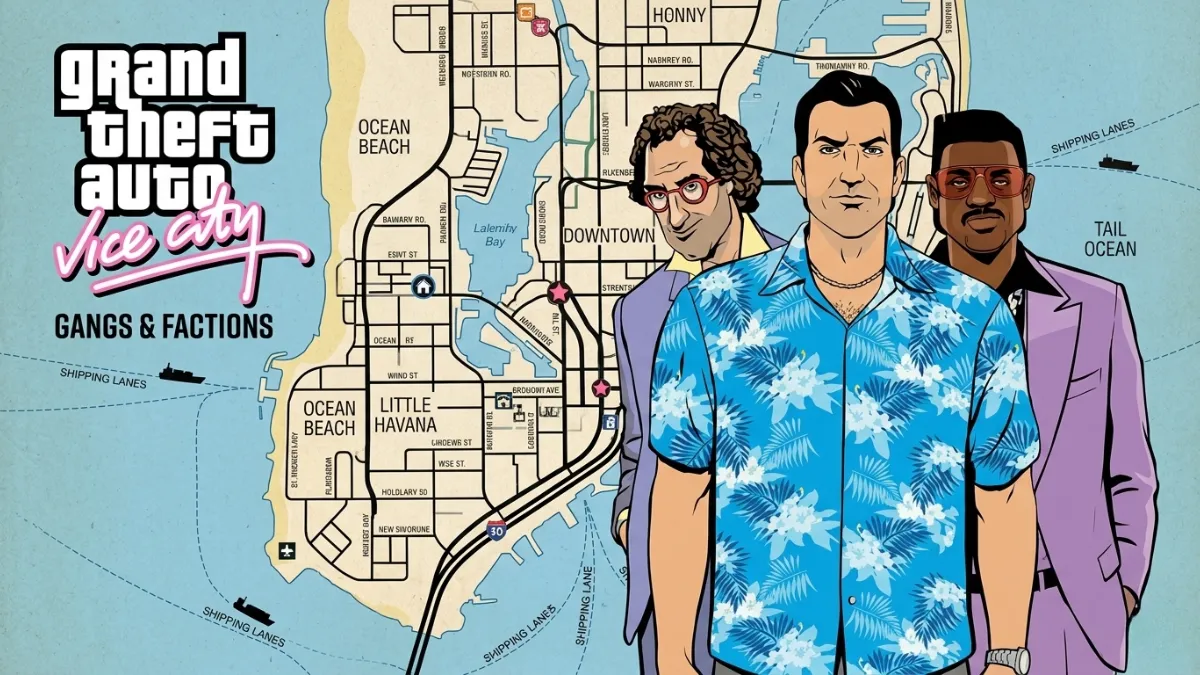
Grand Theft Auto: Vice City Stories presents an earlier version of Vice City compared to the 1986 setting of GTA: Vice City, where the city is still developing, many landmarks are unfinished, and criminal influence is still shifting. The same map exists in both games, but its structure, ownership, and visuals change significantly over time.
Players often search GTA Vice City Stories map to understand how the city evolves between the two timelines.
Major Map & Location Changes (1984 vs 1986)
Vice City in 1984 is a “work-in-progress” version of the later 1986 city. Many familiar places either do not exist yet or are in early development stages.
Key Location Differences
- Moist Palms Hotel appears under construction in Downtown
- Sunshine Autos exists only as a building site
- Phil Cassidy operates from Viceport before relocating later
- Several empire-related zones are active in VCS but removed later
- Gang hubs like warehouse operations are destroyed before VC timeline
- Starfish Island lacks final luxury development details
- Fort Baxter is more accessible due to military storyline integration
These changes make GTA Vice City Stories map feel more dynamic and evolving compared to the final version.
Empire System vs Property System
One of the biggest gameplay differences is how territory and businesses work.
- VCS uses Empire Building mechanics with active criminal expansion
- Vice City uses static asset ownership and income properties
- VCS allows takeover-based progression
- VC focuses on purchasing completed businesses
This shift changes how players interact with the map across both games.
Island Progression System
| Feature | GTA Vice City (1986) | Vice City Stories (1984) |
|---|---|---|
| Starting Area | Vice City Beach (East Island) | Mainland (West Island) |
| Map Unlock | Bridges open later in story | Opposite progression order |
| Safehouses | Fixed luxury properties | Empire-based structures |
| Gameplay Style | Business ownership focus | Empire expansion focus |
This structure is often compared with discussions like Is Liberty City Stories the same as GTA 3 and GTA 3 vs Liberty City Stories due to similar timeline evolution design.
Visual & Environmental Improvements
Even though Vice City Stories was originally a PSP title, it introduced noticeable upgrades compared to the original Vice City.
Lighting & Atmosphere
- More detailed neon lighting across city streets
- Stronger nighttime reflections
- Improved ambient city glow
Color & World Style
- Warmer, golden-hour tropical tone
- More saturated vegetation and ocean visuals
- Cleaner environmental contrast
Water & Gameplay Physics
- Fully functional swimming mechanics
- Improved wave and water motion effects
- More interactive shoreline environments
GTA Vice City Map Differences Overview
| Category | Vice City Stories (1984) | Vice City (1986) |
|---|---|---|
| City Status | Under development | Fully established |
| Sunshine Autos | Construction site | Fully operating business |
| Empire System | Active takeover system | Removed / replaced |
| Fort Baxter | More accessible | Restricted military zone |
| Safehouses | Empire compounds | Fixed properties |
| Visual Style | Warmer PSP-era lighting | Classic neon 80s style |
| Map Progression | Mainland first | Beach first |
Frequently Asked Questions
Yes, both games use the same city layout, but time periods and details differ.
Because it takes place in 1984, when the city is still under construction and development.
Most locations exist in both, but some are missing, changed, or redesigned.
Empire building zones in VCS are replaced by static properties in Vice City.
Final Thoughts
The difference between Vice City Stories and Vice City is not just visual—it reflects how the entire city evolves over time. From construction zones and empire systems in 1984 to a fully developed criminal empire in 1986, both maps together create a layered world that feels alive and historically connected.
Disclaimer
This article is for informational and educational purposes only. Grand Theft Auto: Vice City and Grand Theft Auto: Vice City Stories are fictional video games created by Rockstar Games. All locations, systems, and events described are part of a fictional universe and do not represent real-world places or organizations.